

1.- INTRODUCTION
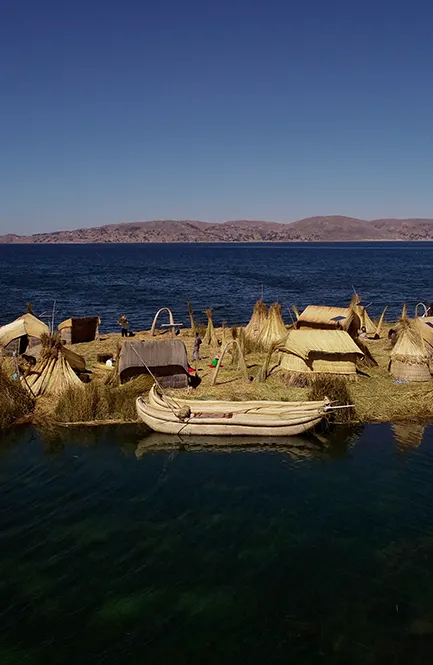
Textile Tours in Peru are considered culturally-driven experiences that seek to immerse travelers in authentic activities that allow them to surpass the expectations of a destination. These activities have a historical legacy within the country, which is why they are only carried out within communities of Andean origin, which are primarily recognized for preserving and inheriting these ancestral techniques. In many of these cases, they are located primarily in the Andean region, and are part of the main places known as large cities. Among the most important towns are Chinchero, Pisac, Patabamba, and others located within the extensive Sacred Valley of the Incas. The same is true of some of the natural and artificial islands found within Lake Titicaca, such as Taquile, Amantani, and Uros, and in nearby places such as the Capachica Peninsula.
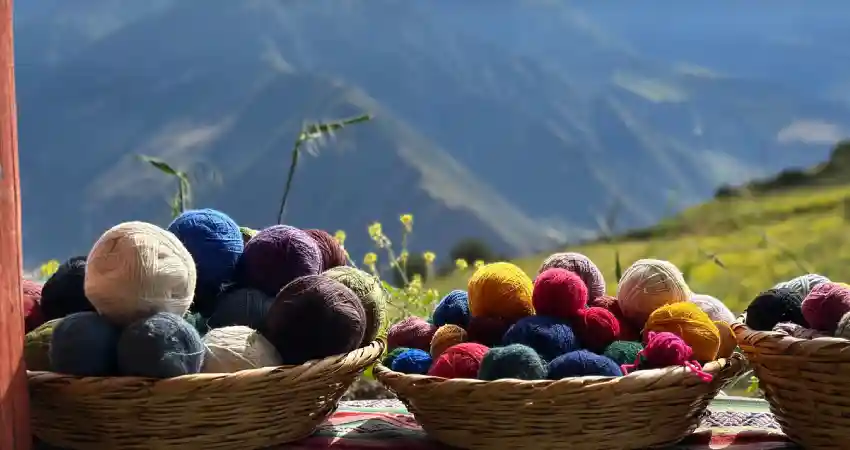
Each of the places considered to carry out activities related to fabrics and textiles have the ability to not only offer this experience in a colorful way, in fact it is sought that each traveler can immerse themselves and actively participate in these activities for which they are invited to be part of each stage of this process considering first the shearing stage where the cuts are made to collect the wool of the chosen camelids such as the alpaca or the llama to later process them and spin them into balls, the process then continues with the dyeing which is done with many elements of natural origin such as pigments based on insects or plants that are in the environment, finally the process ends with the elaboration of various designs using mainly traditional looms which have an ancestral and cultural function for many generations so the technique used is ancestral. Each Andean community independently offers a warm welcome to all travelers, opening their doors and seeking to share their history, its importance to this day, the symbolism it represents in their daily lives, and the identity directly linked to each sample of this textile art, making weaving tours in Peru unforgettable and unique experiences.
1.1.- What are Textile Tours in Peru?
A textile tour Peru is categorized as a cultural travel style that seeks to connect travelers with a practical activity that has been present in Peru since the earliest civilizations developed in this territory. Andean weaving is a vital part of the culture and is primarily carried out in experiential workshops established inside family homes, where demonstrations are given of how its practice has been passed down for generations to the various communities that keep this tradition alive to this day through symbols, colors, and many ancestral techniques.
| “Wander often, wonder always.” |
1.2.- Popularity of Weaving Experiences
In recent years, experiences that involve moments of direct interaction with Andean communities, and even more so with local people, have become increasingly popular. They have become one of the main activities sought by travelers. They enjoy direct contact and learn about the lifestyle of many Andean communities. They seek to escape the mass tourist destinations where thousands of travelers arrive each year. Textile Tours in Peru provide a unique cultural opportunity for travelers who also crave human connection. In more ways than one, these activities are not only present in visual art, they are also about teaching the language with which to convey the story, belief, and spirituality that have a deep relationship with nature. Therefore, each textile becomes a unique experience that, when interpreted, can convey everything important that a culture wants to convey.
2.- HISTORICAL LEGACY
For many world travelers, choosing one of the weaving tours in Peru represents a view through a living window that allows you to travel back in time to the history of Andean culture. This trip is primarily about appreciating the art that exists within the weaving, allowing us not only to enjoy and learn about the cultural technique that has been passed down for generations, but also to interpret the profound knowledge that exists in the symbolic and spiritual environment. For centuries, fibers obtained from Andean camelids such as the alpaca, llama, and vicuña have been the primary elements transformed into personalized expressions that capture the cultural identity of Andean communities. Each fiber possesses a meaning directly related to aspects of belief, such as the Andean worldview. Fibers represent a person’s social status and, ultimately, their connection with nature. This art form is not just an artisanal technique for expressing beliefs; it is also considered a unique cultural legacy that has managed to survive the test of time and be passed down through generations, allowing the collective memory of Andean communities to remain almost intact despite the passage of time.
History has shown that multiple cultures preceding the Inca have provided a contribution within this ancient heritage, standing out mainly for the mastery of their technique in addition to their use at different moments of life, among the main ones we can highlight the Paracas culture being one of the main civilizations that developed an impressive technique for the elaboration of textiles, even achieving embroidered mantles that are known mainly for being used in funeral spaces, over time the Nazca culture also developed this technique as an inheritance from its predecessors, embedding the use of intense colors to represent different moments of daily life, then this knowledge reached the Wari culture to be perfected, creating tapestry techniques, increasing its complexity where various aspects of the same culture were shown, such as religion, social status and even daily life and representation of deities.
The knowledge finally reached the Inca culture who established that the practice of weaving was a fundamental aspect that should be part of the nobility where there was power, prestige as well as spirituality, currently a large part of the Andean populations that are found in the Andean region have inherited this knowledge and have transmitted it for generations allowing that until today it is possible to appreciate its beauty, places like Chinchero, Pisac, Amantani, Taquile and others have managed to keep this tradition alive and in search of promoting this knowledge they open their doors so that world travelers can enjoy a unique connection with the culture creating an authentic exchange, teaching every moment of the elaboration process so that these textiles become more than a souvenir, they represent the cultural encounter of two places in the world where history and knowledge are reflected in each thread that the fabrics contain.
3.- CULTURAL RECOGNITION
“Textile art is not only a demonstration of knowledge; it is, in fact, a legacy inherited for generations. Its importance has been recognized by various organizations around the world, most notably by UNESCO’s designation of it as intangible cultural heritage of humanity.”
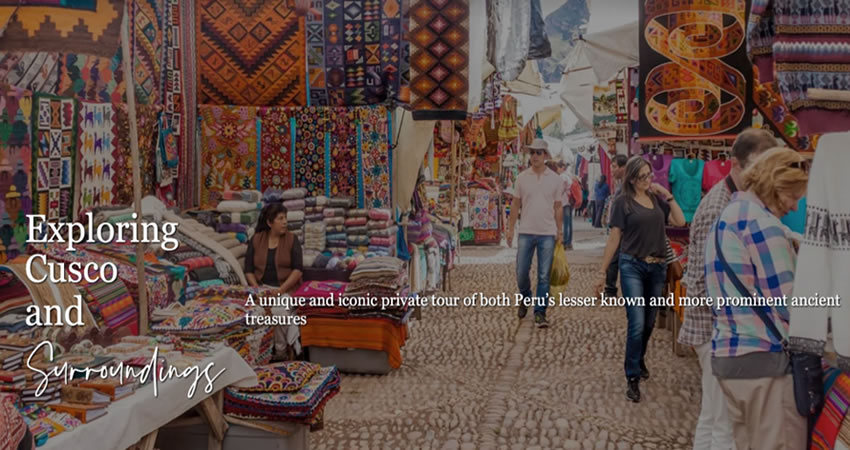
4.- BEST TEXTILE TOURS IN CUSCO
Textile Tours in Peru take place primarily within the Andean region, where the practice of textiles is a cultural heritage preserved since the time of pre-Columbian cultures. Some of the main places where you can enjoy these experiences are:
- Chinchero – the most iconic Andean weaving tour in the Sacred Valley
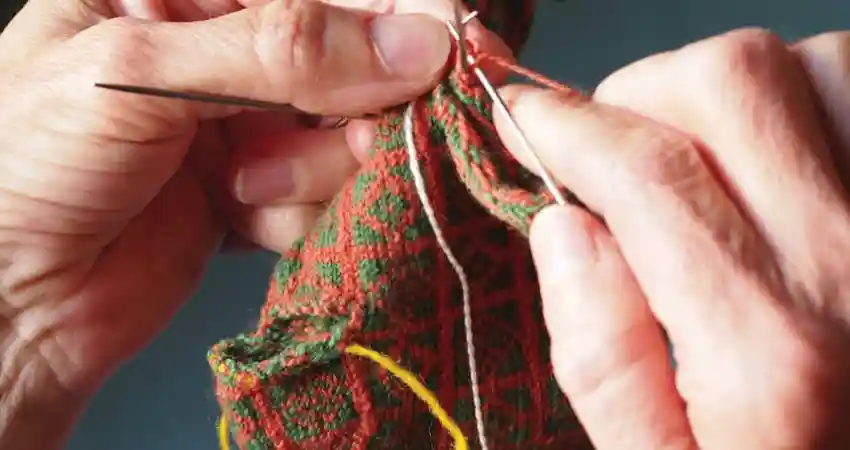
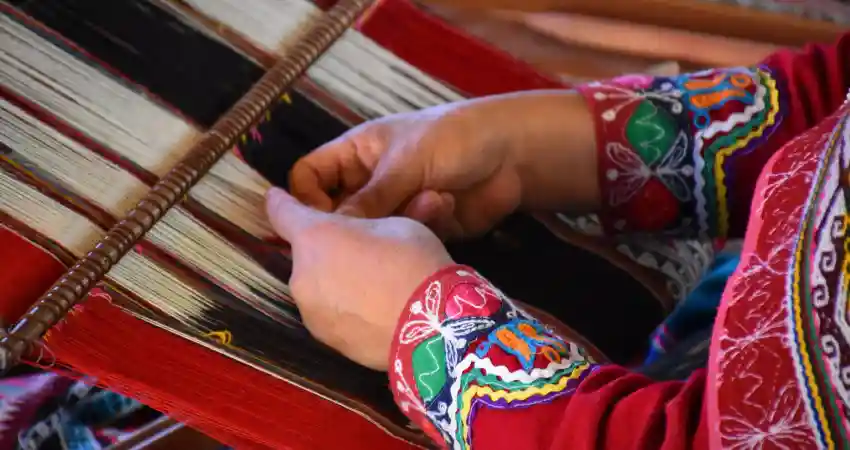
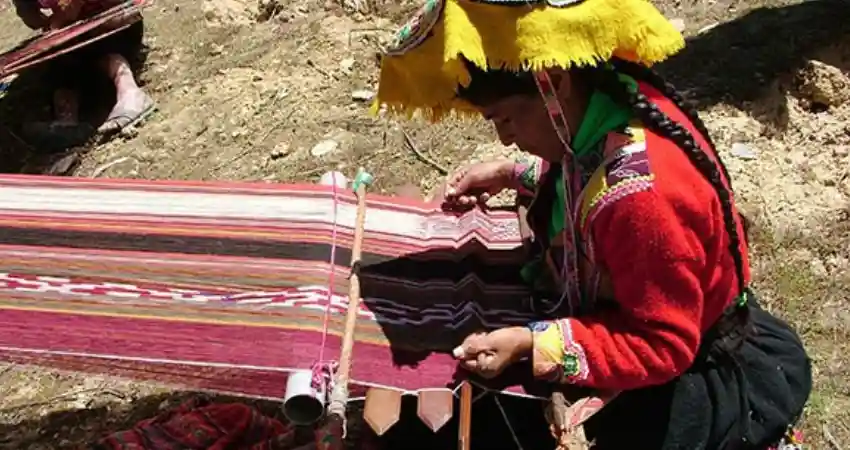
The traditional town of Chinchero is also known as the birthplace of textile art throughout the Cusco region. Here you can enjoy a unique connection with the culture, as local women have preserved many ancestral techniques for each step of the textile-making process. This experience consists of learning about each of the steps involved, from the spinning process, where a real-life demonstration is given of how the wool is collected and transformed into the fine ball of wool we know today. Natural dyeing is then demonstrated using many natural elements such as cochineal, coca leaves, firestone, and others, which are used to obtain different shades to create beautiful textiles of various colors. Finally, we arrive at the weaving process using a waist loom, a cultural element that has also been historically passed down through families. Knowledgeable about this art, visitors have the opportunity to witness real-time demonstrations and participate in them at various times to finally create these pieces made from alpaca, vicuña, and sheep wool. Best of all, it takes place in a traditional setting.
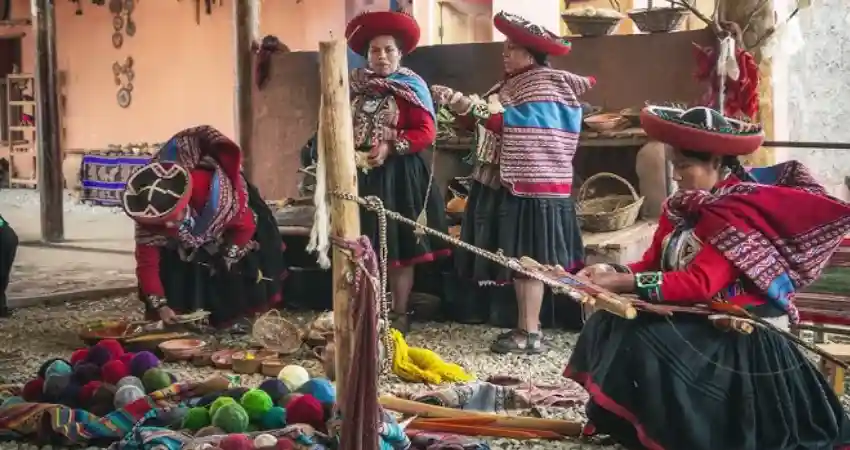
- Amaru – community-based traditional weaving experience near Pisac
This place is a community center where traditional weaving is carried out and is located within the Sacred Valley near the town of Pisac. It is less well-known in popularity than other places, but it offers a unique immersive experience for travelers, showcasing the breadth of the Andean textile world in a close-up view. This place is primarily characterized by allowing interaction with local families who are committed and focused on teaching the entire weaving process to travelers seeking to connect with the Andean world. To this end, every stage of the process is taken into account, from shearing, where docile alpacas are used, to the dyeing process, which primarily requires native plants to diversify the colors. The entire process provides an authentic connection with Andean culture and worldview, which is constantly reflected as an inspiration for the creation of diverse and complex designs.
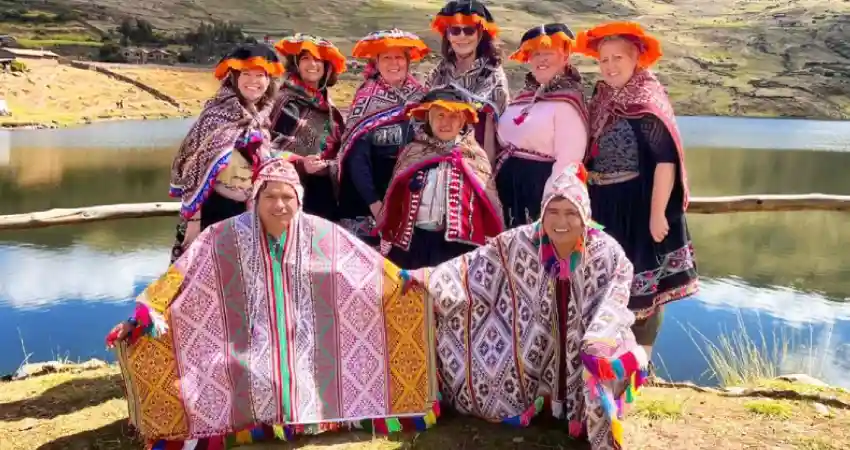
- Patacancha & Willoq – indigenous textile communities with hands-on weaving workshops
These are two renowned communities within the Sacred Valley, primarily characterized by their proximity to the traditional village of Ollantaytambo. They undoubtedly stand out as places where the textile tradition remains alive, thanks to a cultural heritage that spans generations. This allows ancestral knowledge to be passed down intact, allowing them to showcase it to the world through one of their works of art. Visitors here are not only spectators of a collection of unique and beautiful textiles, handcrafted using ancient techniques, but are also invited to participate in established, hands-on workshops to learn the weaving technique using original customs. They are also invited to interpret the Andean symbols reflected in each garment, understanding its purpose and enjoying it when worn. The pieces of art are always available for purchase.
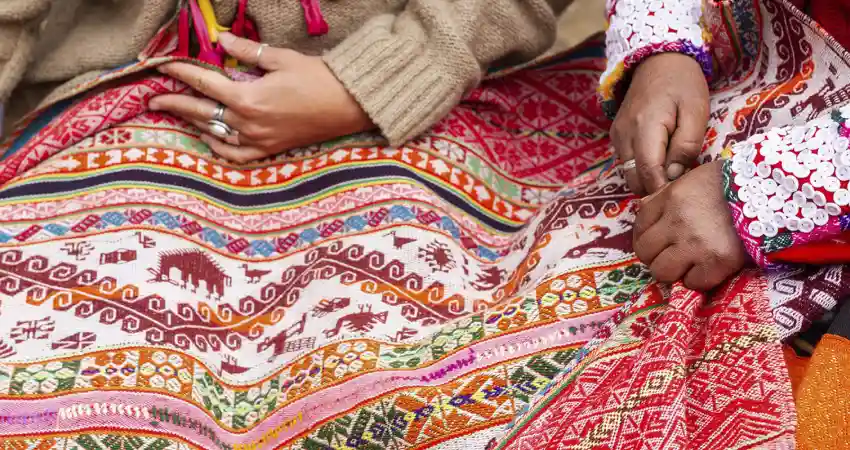
- CTTC (Cusco city) – Peruvian textile museum and weaving workshops
Cusco’s renowned traditional textile center is considered an institution primarily dedicated to the preservation of textile arts, but also seeks to promote the understanding that each of these pieces represents. Art exhibitions are held where the cultural richness showcases the skills and talents of many communities located near the city. At the same time, it offers interactive workshops where visitors learn about the history, purpose, and importance of each of the ancestral textiles, which in many cases are linked to social status, while others simply seek to represent the Peruvian identity inherited from pre-Columbian cultures.
5.- TEXTILE / WEAVING TOURS IN LAKE TITICACA
These activities can also be enjoyed in other parts of the Andean region. Near Puno is Lake Titicaca, a natural destination renowned for its beauty, but also for its cultural heritage. Various cultures have developed within its interior, and due to its location, they have preserved their cultural heritage intact.
- Taquile Island – UNESCO-recognized Peruvian weaving tradition
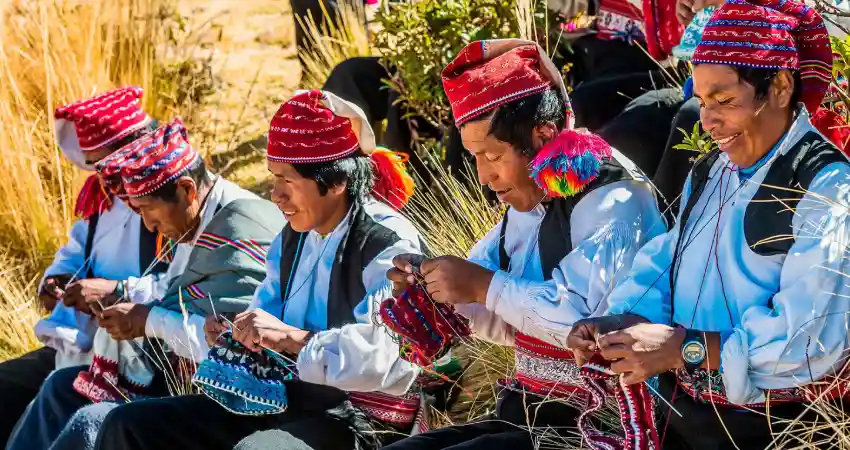
The natural island of Taquile is located within Lake Titicaca and is primarily recognized for its textile art so beautiful that UNESCO has even declared it an Intangible Cultural Heritage of Humanity. This is mainly due to the fact that weaving techniques have been passed down for generations among its inhabitants, even since pre-Columbian times. The most interesting thing about this place is undoubtedly that it is the men who have the most refined techniques, creating various types of Andean hats, also known as chullos, while the women are primarily responsible for the spinning and natural dyeing process. Here, each piece of textile is a reflection and symbol of the ancestral connection that exists, in addition to the transmitted identity, history, and belonging that every traveler can discover when visiting this natural place.
- Amantaní Island – cultural weaving experience with a local family
More than just discovering a new destination, it is also about living a unique community experience; this is precisely what Amantani Island offers the world. Here the practice of traditional weaving is part of people’s daily lives and is represented as a symbol of connection with culture, traditionally this is one of the islands where travelers decide to spend the night inside family homes and it is here directly where travelers have the opportunity to learn and know the process of spinning and embroidery as a practice of the hosts, all while sharing the customs of each family and enjoying unique moments such as typical scenes and storytelling, this experience is one of the most valuable cultural immersions since it directly combines the nature of the charm of Lake Titicaca, the hospitality of local families and the craftsmanship captured in textiles that tell different stories.
Now you know everything you need to start planning your next trip. Auri Peru is not just a travel agency, but also a specialist in designing cultural experiences where, beyond getting to know the destinations, you get to interpret their history in a unique way. Contac us now and enjoy a trip with purpose.
“Not all who wander are lost.”