


1.- WHAT IS A SAN PEDRO CEREMONY?
The Peru San Pedro Ceremony, popularly known as Huachuma, is considered an ancestral ceremonial practice of Andean origin. The Echinopsis Pachanoi cactus is used in search of spiritual healing. In other cases, the San Pedro Ceremony Peru is used for healing and to find a connection with nature. Its practice dates back thousands of years, around 3,000 years, and has been passed down among various cultures through representation in handicrafts and ceramics, where the process is captured in petroglyphs. Today, the Peru San Pedro Ceremony is practiced exclusively under the guidance of expert spiritual guides who are knowledgeable about the Andean worldview as well as techniques incorporated by contemporary times.
Echinopsis pachanoi is considered a cactus variety native to the high Andean regions of Peru, Ecuador, and Bolivia. In fact, this is part of its characteristics, as it only grows in areas between 2,000 and 3,000 meters above sea level. Its characteristic color is bright green, and it also has white flowers with an intense scent that open primarily at night. Its adaptation has allowed it to develop a resistance that has positioned it as one of the most significant Andean plants in sacred ceremonies for many communities.
What makes the Peru San Pedro Ceremony special is primarily its composition. This plant contains mescaline, which is considered part of the family of psychoactive alkaloids. These alkaloids have an entheogenic effect that causes an expansion of the senses, in addition to directly affecting vision, which helps with personal introspection. Its effect lasts mainly from 8 to 12 hours, during which one feels a special connection with nature. It also achieves mental clarity and emotional peace. However, it must be performed in a safe and controlled space, in addition to the company of an expert spiritual guide.
1.2.- Contexts of Use
Within Andean belief, it is known that the Peru San Pedro Ceremony is used primarily as part of alternative medicine, primarily for energetic cleansing, emotional healing, and spiritual encounter. This ceremony also includes prayers and chants, which are primarily directed to Mother Earth. Although the San Pedro Ceremony Peru is traditionally used for spiritual and ceremonial purposes, in recent years it has become an activity attracting world travelers seeking a restorative experience and spiritual well-being. This also promotes ancestral knowledge, preserves authenticity, and prevents its commercialization from becoming decontextualized and straying from the sacred focus.
1.3.- Comparison with other medicinal plants
The Peru San Pedro Ceremony is popularly compared to the Ayahuasca ceremony. Although both are used for ceremonial and ritual purposes in South America, they differ primarily in origin. Ayahuasca comes from the Amazon and contains a combination of vines and leaves that contain DMT, which produces more intense but short-lived effects. The Peru San Pedro Ceremony, on the other hand, comes from an Andean tradition and offers a more prolonged experience, which is interpreted through gentle experiences for the purpose of contemplation, leading to intrapersonal interpretation.
There is also a comparison with the Peyote known scientifically as Lophophora Williamsii, this cactus has its origin in Central America within Mexico which has Mescaline in an intense concentration, on the other hand due to the characteristics that the San Pedro has it only develops in Andean climates and has a larger size compared to the Peyote because its growth is much slower, this has also made it one of the most important ceremonial plants in Mexico and part of the United States, however the San Pedro is more oriented to ceremonies within the Andes.
2.- ANCIENT ORIGINS AND CULTURAL SIGNIFICANCE
2.1.- Pre-Columbian History
- Archaeological Evidence (Chavín Culture)
Historically, the use of the Echinopsis pachanoi cactus is associated with the development of the Chavin culture, which emerged between 1200 and 400 BC. This culture was one of the most influential in shaping Andean beliefs. Archaeological remains of this culture can still be found in the Ancash region. Its main temple, which features various monoliths and carvings associated with anthropomorphic figures holding a cactus, demonstrates how this sacred plant was part of religious ceremonies and held significant significance within that culture.
- Moche and Nazca Civilizations
Over time, various cultures also emerged, such as the Moche between 100 and 700 BC, and the Nazca culture between 100 and 800 BC. Thanks to various studies, it has been determined that the Peru San Pedro Ceremony also continued to be practiced, although it no longer focused solely on religious aspects; in fact, rituals for healing and divination were integrated. Evidence found in handicrafts, ceramics, and even textiles has included iconography depicting priests and deities considered directly associated and connected with this cactus. The Nazca culture primarily linked its existence to geoglyphs and agricultural practices, preserving its relationship with fertility and natural balance.
2.2.- Chronology of Use
Considering archaeological discoveries and most ethnographic records, it is clear that this traditional plant has been used by various cultures throughout history and has developed in the Andes for more than three millennia. Its practice stands out as one of the longest-standing medicinal and spiritual traditions. This practice is maintained primarily due to its symbolic relevance and its very special connection between the earthly and spiritual worlds.
2.3.- Traditional Indigenous Practices
To this day, many Andean communities use the Peru San Pedro Ceremony as part of their alternative medicine, seeking to purify the body and spirit, as well as seeking effective treatment for physical pain and eventually healing the emotional suffering a person may experience. Generally, the ceremony involves a combination of ritual chants, prayers, and offerings, all in the pursuit of creating a harmonious connection with nature and Mother Earth.
Spiritual guides are primarily master healers, shamans, or also known as paqos, who represent the main figures in the ceremony. They prepare the cactus infusion, provide spiritual guidance to the participants, direct the ceremony, and interpret any visions that may occur. Their role is not only medicinal; they also serve a protective purpose, ensuring that the ceremony can take place within a safe spiritual framework.
The Peru San Pedro Ceremony can have several variations depending on the region in which you experience it. Traditionally, in the Andes located in northern Peru, some aromatic plants are included, which gives a different feeling when experiencing it. In the case of the coast, it adheres to characteristics of syncretism, so images from the Christian religion are included within the ceremonies to give it a direction more familiar to most participants. In the case of the central Andes, aspects of traditional dance and music are considered.
3.- THE MEANING OF ITS NAME
“One aspect that very few people know is that its distinctive name, Saint Peter, is directly related to the Catholic apostle who is also known as the keeper of the keys to heaven. Many people who have experienced this process claim that the plant has properties that open doors to other dimensions linked to spirituality, which can only be enjoyed in an energetic natural setting like the Andes or the Amazon.”
4.- HOW SAN PEDRO CEREMONIES WORK
4.1.- Preparation
The San Pedro Ceremony Peru begins long before the ceremony itself. Among the recommendations, there is a physical and spiritual preparation process that must be followed before this important moment. This is associated with light diets, reducing alcohol and caffeine consumption, and avoiding red meat and processed foods. This is the phase popularly known as the diet and is primarily aimed at purifying the body and mind, facilitating a profound and harmonious experience with the environment and nature. Some participants also choose to perform other associated rituals, such as cleansing with aromatic plants, popularly known as flowering baths.
4.2.- Opening Rituals and Prayers
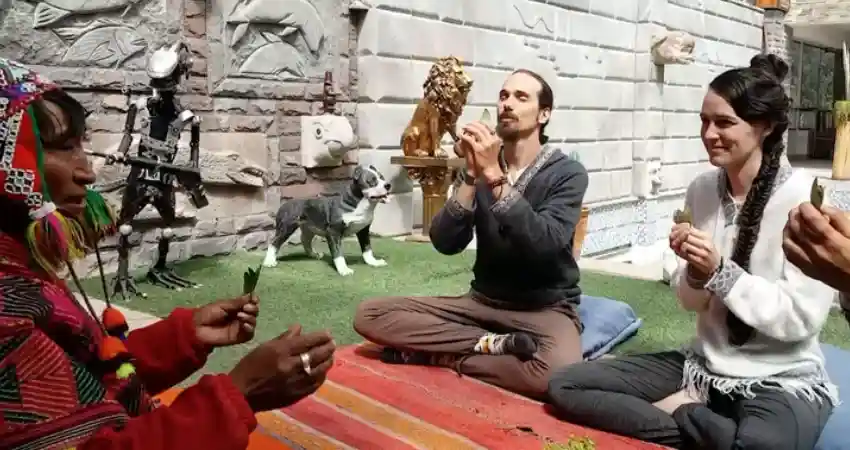
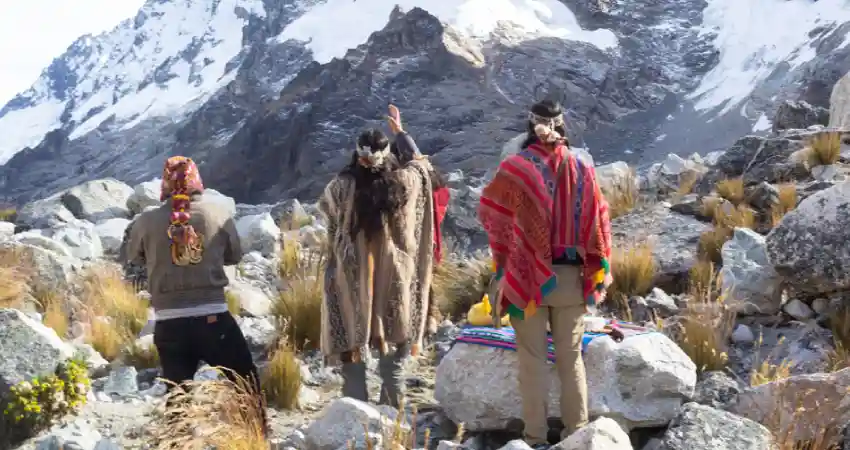
This experience begins primarily at dawn or during the early hours of the day, where prayers are offered to Pachamama and the apus, traditionally known as mountain spirits. This is to ask for and invoke protection and guidance throughout the process. During this time, the healer is responsible for preparing the table or altar where all the symbolic offerings are placed, highlighting coca leaves, flowers, tobacco, and water, which helps with the transition to a safe space.
4.3.- Consumption Method
Traditionally, the cactus is consumed in a concentrated infusion, which is obtained by boiling the cactus for several hours. The first part is done in the morning, so the experience can take place throughout the day, mainly in a natural setting. If necessary, a second dose is consumed at the recommendation and perspective of the healer, seeking to achieve a longer-lasting effect.
4.4.- Guided Journey
After consuming the cactus, the participant undergoes an experience known as an introspective journey, which allows them to feel an expansion of their perception of their surroundings. Meanwhile, the healer is responsible for guiding the entire process, singing, praying, and occasionally remaining silent to enhance the experience. Finally, a collective integration takes place where all participants share their experiences. This is where the healer begins to play a more important role, interpreting each situation, which contributes to the learning process and guides the healing process.
4.5.- Sacred Elements and Tools
The most important element of this process is undoubtedly the sacred table or altar, which many consider the physical and visual heart of the ceremony itself. A tablecloth is placed on which various objects are positioned that represent the existence of three worlds that are part of Andean belief: the upper world (Hanan Pacha), the earthly world (Kay Pacha), and the spiritual world (Uku Pacha). Among the traditional elements, you can find carved stones, seashells, some carved animal figures, candles, containers of water, coca leaves, and even flowers. All of these objects have a very special meaning and are placed intentionally in an effort to balance the energies present in the place.
There is no doubt that one of the main features that helps guide travelers in this process is music. Ceremonial chants, also known as Icaros, are combined with various melodies performed with wind instruments such as the quena and the pututuo, accompanied by a small drum, in search of a rhythm. This helps to establish a meditative state that, through the consumption of the cactus, creates visions. Each of the songs is passed down from master to apprentice to preserve the tradition for generations. They are a vital part of the essence of spiritual medicine.
5.- BEST PLACES FOR SAN PEDRO CEREMONIES IN PERU
5.1.- Pisac and Traditional Centers
The traditional village of Pisac is located within the Sacred Valley of the Incas, making it one of the main tourist destinations for world travelers. However, it also enjoys a ceremonial popularity, where the consumption of San Pedro is carried out thanks to the natural surroundings, which also demonstrate what a constant source of spiritual energy it is. There are many traditional centers that combine Andean ceremonies with some contemporary healing techniques, often represented in places such as agricultural terraces or near sacred rivers. Most of these centers work only with small groups so that the experience can be more personalized and profound.
5.2.- Ollantaytambo
This town is also known as the Living Inca Village, primarily because the ceremonies held here are characterized by mountainous surroundings and important archaeological sites, offering ceremonies that are more connected to the culture and nature. Ceremonies are often held at dawn, and the proximity to the temples and natural viewpoints is sought, helping to create a better connection with the Apus and Mother Earth.
5.3.- Cusco
The ancient capital of the Inca culture is centered around this city, where specialized retreat centers have been established. These centers combine the experience of consuming San Pedro with other therapies such as yoga, meditation, sound baths, and others. The purpose of these experiences is to be combined with other excursions that include archaeological sites and ceremonies held at sacred sites like Saqsayhuaman, where historical and cultural aspects come together to provide a deeper immersion for participants.
5.4.- Northern Peru
There are also special places where this ceremony can become even more special due to the surroundings. One of the best known is undoubtedly Ica, where the arid terrain is characterized by sand dunes and the unique huacachina oasis. However, San Pedro ceremonies are also held here, seeking to enhance the desert environment for a more special introspective experience. This still space, combined with the clear desert sky, provides an ideal environment for meditation and inner connection.
On the northern coast, the city of Trujillo combines a wide archaeological variety, highlighting the ancient Chan Chan citadels and the Moche Huacas, where ceremonies are performed by local healers and are oriented toward spiritual retreats. Despite its remote location, it is close to rural areas, making the experience more isolated and creating a more special connection with nature.
It is also in the city of Cajamarca, located in the northern region, where healing traditions are recognized by the presence of master healers who have an ancestral lineage. Each ceremony is performed mainly in the highest part of the mountains or near hot springs, giving it the sense of cleansing and purification before the main ceremony.
| “Escape the ordinary, embrace the extraordinary.” |
6.- FREQUENTLY ASKED QUESTIONS
- What is San Pedro ceremony in Peru?
It is a ritual of Andean origin that uses a variety of cactus known as Echinopsis pachanoi for spiritual and healing purposes, and in search of a connection with nature. It is traditionally performed under the supervision of a spiritual guide.
- How long does a San Pedro ceremony last?
The duration varies depending on the type of experience chosen, although it can traditionally last between 8 and 12 hours because it almost always begins in the early morning.
- What is the difference between San Pedro and Ayahuasca?
The main difference lies in its origin. While San Pedro originates in the Andes and contains the alkaloid mescaline as its main element, it has a longer but milder sensation. Ayahuasca, on the other hand, is of Amazonian origin and contains DMT, which generates much more intense visions but lasts less time.
- Is San Pedro ceremony safe?
This ceremony follows safety parameters, which is directly associated with a comfortable experience for all travelers. Furthermore, since it is spiritually guided by a healer and performed in a safe environment, there are no potential risks. Of course, for people with conditions such as heart problems, uncontrolled hypertension, or psychiatric disorders, it is best to refrain from the experience.
- What does San Pedro cactus do to you?
It is associated with an expansion of sensory perception, helps clear the mind, creates personal introspection, and generates a sense of special connection with nature through symbolic visions, which are later interpreted by the spiritual guide. It can also cause some physical aspects such as nausea and vomiting, which are part of the cleansing process.
Now you know more about this ancient ritual ceremony still practiced in Peru. If you’re looking for a spiritual experience that will highlight your next adventure, then this is the ideal option. Auri Peru can help you live a mystical experience, providing you with all the safety measures you need. Contact us now and enjoy a responsible trip.
“Travel makes you speechless, then a traveler with a story.”