


1.- WHAT ARE THE MACHU PICCHU DEATH STAIRS?
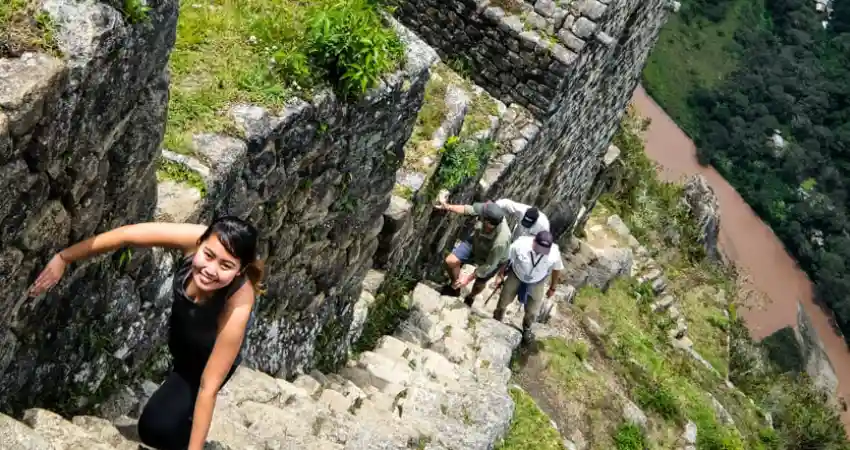
The Machu Picchu stairs of death are still unknown to many, but adventurers looking for a little more excitement when visiting the Inca citadel of Machu Picchu get to know them. It is the most difficult and challenging stretch you can find during the ascent to Huayna Picchu mountain. It is located directly below the Inca city and is considered an ancestral trail or path that was carved into the rock of the mountain by the inhabitants who belonged to the Inca culture. It consists of a series of narrow stone steps with a steep incline and no railings to hold on to. These stairs border the precipice and offer a unique view of the extensive Urubamba River valley. Its reputation has been progressively stimulated by various stories and comments from travelers about the feeling of vertigo it causes and the danger that is constantly felt at every moment, which is why the Machu Picchu death stairs are currently part of the set of risky activities that Cusco and Machu Picchu have to offer.
2.- Origin of the name
The traditional name of the Machu Picchu death stairs has sparked a controversial series of stories, as many have associated it with statistics of accidents with tragic deaths among travelers. However, this is not true. In fact, the name Machu Picchu death stairs comes specifically from the feeling and excitement of high risk that is usually generated while ascending to the highest part of the Inca city. The name was proposed by the hundreds of travelers who have walked this trail and noticed its challenging incline, constant exposure to the void, and notorious proximity to a deep abyss that is only one step away from a direct fall. Historically, its original construction dates back to the Inca culture, but its popularity is current, as travelers’ anecdotes have been shared on blogs, videos, and even social media, which document this experience as a complete test of courage.
3.- Where are the Machu Picchu death stairs?
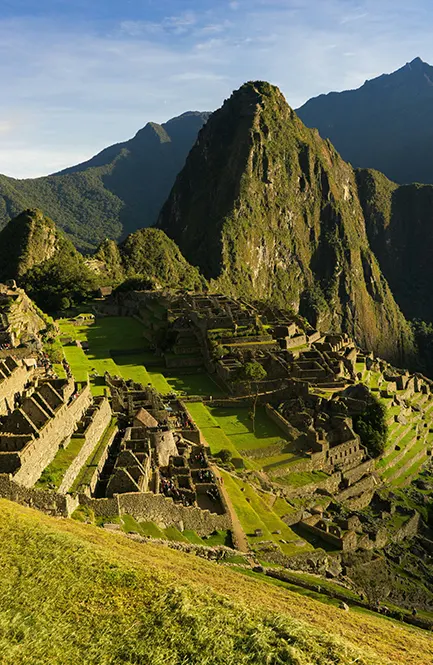
The Huayna Picchu mountain is located specifically north of the Inca Citadel of Machu Picchu and is currently part of the mountain range that comprises the historic sanctuary, which is an area protected by the Peruvian government. It is at the end of this trail that allows the ascent of the mountain, known as the Machu Picchu stairs of death, and in order to access this place, it is necessary to purchase a special entrance ticket in addition to the traditional ticket that allows access to the Inca Citadel of Machu Picchu. Currently, due to tourist control and flow, there are only two schedules that have been established to control the number of visitors. You can choose between the first group between 8:00 a.m. and 9:00 a.m., while the second group is from 10:00 a.m. to 11:00 a.m., with a total of 175 visitors in each group.
4.- WHY ARE THEY CALLED “DEATH STAIRS”? THE REAL DANGERS AND RISKS
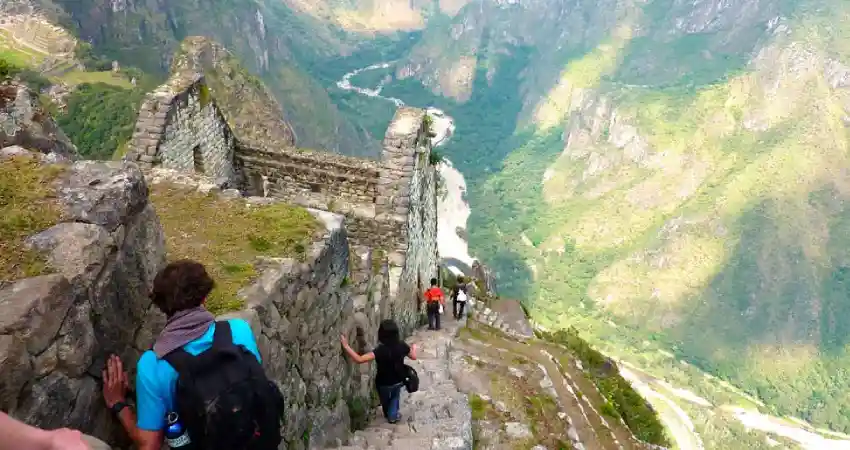
Undoubtedly, the main feature that stands out about the Machu Picchu death stairs is that the narrow steps have been carved directly into the rock, in addition to other spaces where they have been built in irregularly shaped stone blocks that, in more than one instance, allow you to rest part of your foot on them. The path is quite narrow, and the slope easily exceeds 60° and is on the edge of cliffs without a protective railing, making it a complete challenge for travelers from around the world. Add to this the humid conditions or fog in the area, and you have an even more demanding path. For this reason, it is always recommended to take gradual steps in accordance with each traveler’s physical ability and to use the environment for support in order to continue advancing.
4.1.- Height and risk factors
The Death stairs Machu Picchu are also characterized by an ascent that exceeds 2700 m above sea level, and as they are very close to a precipice, there is a free fall of hundreds of meters. This combination of altitude, risk, and lack of safety measures such as railings creates a feeling of vertigo and anxiety among visitors. The absence of oxygen at high altitudes also increases the physical effort required of travelers and increases the percentage of constant fatigue they may feel.
Another important factor to consider is undoubtedly the climate and temperature around the Inca city of Machu Picchu. Due to its proximity to the jungle region, the weather is quite unpredictable, with frequent sudden rains, dense fog, and constant humidity, which can make the trail slippery and dangerous. This mainly occurs during the rainy season in the area, which runs from November to April, increasing risk factors and reducing visibility. During this season, it is more than a recommendation it is an obligation to wear specialized hiking shoes with good traction and to exercise much more caution when climbing the mountain.
4.2.- Incidents and safety records
So far, the official record of accidents on the Death stairs Machu Picchu is pretty rare, as these are isolated reports of falls mainly caused by slippery ground or travelers losing their balance. However, the most frequent cause is usually a consequence of not following the rules or climbing recklessly, such as trying to take a photograph on a narrow section or climbing the mountain with the wrong footwear. Fortunately, most travelers comply with the regulations properly, so there are no frequent cases of accidents.
| “Travel far enough, you meet yourself.” |
In order to be able to act immediately in the event of any accident during the ascent of Huayna Picchu Mountain, the authorities who protect the historic sanctuary in the Inca city of Machu Picchu constantly carry out patrols and monitoring, which include rescue teams and are mainly used to respond to any emergency that may occur. Of course, these are not frequent, as only minor injuries, episodes of anxiety or panic, and physical exhaustion are recorded each year. For this reason, although there is no age restriction, there is a recommendation that only those over 12 years of age may climb this mountain, provided they are in good physical condition.
5.- PLANNING YOUR DEATH STAIRS ADVENTURE: ESSENTIAL PREPARATION
Climbing to the top of Huayna Picchu mountain and overcoming the challenge of the Machu Picchu death stairs is undoubtedly one of the best experiences and thrills a traveler can have when visiting the Inca city. However, it is important to note that this place can only be accessed with an advance reservation, as a very special entrance ticket is required in addition to the one already reserved for the Inca city of Machu Picchu. This ticket is specifically for Circuit 3 – Machu Picchu Royalty on Route 3-A: Huayna Picchu Mountain Route. It is important to make this reservation at least three months in advance, as it can sell out very easily because only 175 people are allowed per time slot, which are distributed among local, national, and, of course, foreign visitors, at a price of S/200.00 soles per person. To purchase your ticket directly, you can visit the official website of the Ministry of Culture.
It is also important to understand that in order to climb to the top of Huayna Picchu Mountain, it is not mandatory to have a tour guide, but it is recommended as this can be very helpful in understanding the historical context and also guarantees the personal safety and integrity of all group participants. At the start of the experience, there is a control booth where you must present your entrance tickets and register.
5.1.- Best time to visit
Another interesting thing about this destination is that it can be visited at any time of the year, although there is always a preference between seasons for a better experience when overcoming the challenge of the Machu Picchu death stairs. The best time to do so is from May to October, which is also known as the dry season, as there is less chance and frequency of rain, meaning that the trails and paths connecting the immense mountain to the Inca citadel are dry and firmer, making the experience safer.
We have also seen that there are two schedules available for visiting. The earlier schedule offers cooler temperatures, which are ideal for hiking and climbing to the top of the mountain. However, there is a high preference for this schedule, as it is the most popular among travelers. so the second schedule offers a more intimate experience with less congestion, although the temperature rises and becomes hotter as you reach the summit. In either case, the average time for the ascent, stay, and descent to finish with a visit to the Inca city is approximately three hours.
5.2.- Training recommendations
You don’t need to be an expert hiker or athlete to climb this mountain, but it is recommended that you have some previous experience to be able to cope with the difficulty of this adventure. This consists of regular resistance training and stair climbing, which is essential cardiovascular training that also helps you adapt to the altitude and cope more easily with the steep slope during the last section.
6.- WHAT TO EXPECT FROM THE EXPERIENCE
6.1.- First section: Moderate ascent
The start of the hike offers a gradual and uncomplicated path. It is the beginning of the ascent where you will find irregular steps that are completely surrounded by a cloud forest, which provides natural protection. This is the part where travelers acclimatize and adapt to the physical effort required while enjoying a calm environment to set the necessary pace for the ascent.
6.2.- Second section: The great challenge
This is where the most difficult part of the challenge begins. It consists of a series of steps carved into the rocks with a fairly steep incline. The steps ascend to the edge of a precipice, so caution must be exercised both on the ascent and descent, as there is no safety railing on the side. These steps are quite narrow and irregular in size, so in some parts it is necessary to use your hands to maintain balance, as the stone may be damp and the slope makes it more difficult. The constant feeling of vertigo also increases this difficulty, so it is always recommended to remain calm and try not to look down in order to maintain a steady pace.
7.- SAFETY AND HEALTH
“For travelers who have medical diagnoses such as vertigo, hypertension or heart problems, it is important that before making the trip they consult a doctor. It is important to understand that this route should be avoided altogether for people who have a fear of heights or claustrophobia, since being very narrow can represent a trigger but an episode of panic.”
8.- FAQs ABOUT MACHU PICCHU DEATH STAIRS
- How dangerous are the Death stairs Machu Picchu really?
The popularity of the Machu Picchu death stairs is due to the fact that they are located at the highest point of Huayna Picchu mountain, which has a fairly steep incline and narrow stone steps, as well as lacking a handrail to hold on to when going up or down. It is considered an exciting but also dangerous experience.
- How many people have died on the Death Stairs?
There is no official record of the exact number of incidents; there are only reports of isolated cases involving falls due to personal recklessness or bad weather, as well as health conditions that may have existed prior to the trip. These cases are actually very rare, as most travelers comply with the regulations mentioned above and enjoy the experience without complications.
- Are the Death Stairs suitable for beginners?
No, this experience is not recommended for travelers who consider themselves beginners or inexperienced, as the geography requires specialized equipment, optimal physical condition, and regular physical activity.
- What is the success rate for completing the Death Stairs climb?
It is quite high, but people who meet the physical requirements and follow the safety instructions have, to date, numbered in the thousands each year and have completed it without complications, including this challenging section.
- Is there an age limit for climbing the Death Stairs?
There is no age restriction, but there is a recommendation that only those over 12 years of age can climb this mountain, as younger people may suffer from panic attacks and, due to their young age, may not have sufficient physical endurance.

Now you know everything about this dangerous but exciting destination, and the best part is that you still have time to experience it in 2025. Auri Peru is one of the few companies that can plan this adventure safely for you, including the company of a specialized guide who will provide support along the way. Contact us now and discover how to take the first step with us.
“Life is short, but the world is wide.”